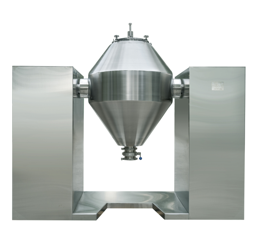
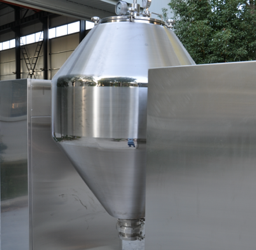
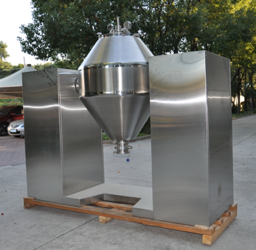
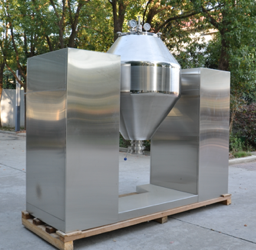
Equipment Characteristics
· Equipped with a two-stage elastic connection method of belt and chain, ensuring smooth operation;
· Specially designed tooling ensures good concentricity of the left and right rotation shafts;
· Reliable rotary joints are used for both the heating medium and vacuum system;
· The heating system can have multiple options, that is to say, the heating medium can be selected from high-temperature heat transfer oil, medium-temperature steam, or low-temperature hot water.
Influence Factors
The condition of the dried material (such as material shape, size, and stacking method), as well as the moisture content, density, viscosity, and other properties of the material itself. In addition, methods such as increasing the initial temperature of the material, pre-treatment through vacuum filtration, and reducing the moisture content of the material can all improve the vacuum drying speed.
Material bulk density: The bulk density of a material refers to the mass of the material per unit volume. Because the material is a mixture of dry and wet materials, which are often in the form of granules or powders, the gaps between the particles of the dry material are also different due to the different wet content in the material. Therefore, there is also a significant difference in the bulk density between the original wet material and the material during the drying process, which requires special attention during raw material preparation.
The allowable temperature of materials: The allowable temperature is the highest temperature that a material can withstand. Exceeding this temperature will cause a change in material potency, decomposition, or discoloration. Heat-sensitive drugs can generally be used at around 60 °C.
Material viscosity: The viscosity of the material changes with the moisture content, and the viscosity can cause the material to agglomerate into blocks and adhere to the cylinder wall. After drying, it is easy to adhere to the dust collector and pipeline. To solve this problem, our company has recently developed a suspension-type double-cone rotary vacuum dryer that uses pneumatic vibration and crushing devices.
The higher the vacuum, the more conducive it is to the vaporization of water at lower temperatures. However, if the vacuum is too high, it is not conducive to heat conduction and affects the heating effect of the material. To improve the drying speed of materials, the vacuum degree should be comprehensively considered based on the characteristics of the materials.
Parameter List
| Specification | SZG-750 |
| Total Volume(L) | 750 |
| Working Volume(L) | 375 |
| Heating Area(㎡) | 3.9 |
| Rotate Speed(rpm) | 3-10 |
| Power(KW) | 3.0 |
| Overall Dimensions (mm) | 2750*1100*2800 |
| Design Pressure Inside the lank (Mpa) | -0.096—0.1 |
| Jacket Design Pressure (Mpa) | ≤0.3 |
| Equipment Weight(KG) | 2000 |
Product Advantages
1. Excellent workmanship
2. Equipment verification and complete file system
3. Customized process control system on demand
4. The conical heads are all circular arc transitions of spinning heads.
Ordering instructions
Heating can be divided into various forms, such as hot water and heat transfer oil heating.
Please indicate the temperature that the material can withstand or the operating temperature of the dryer when placing an order, so that our factory can choose or provide a heat source for you.
The accessories involved in the vacuum drying system can be provided and installed by our factory for users. Please specify them in your order.
Our factory can provide design, manufacturing, and installation services for special requests from users.